 Explore articles
Synthesis of Low Cost Carbon Replica for Paracetamol Removal from Waste Water and Effect of Temperature on Adsorption Capacity
Abstract
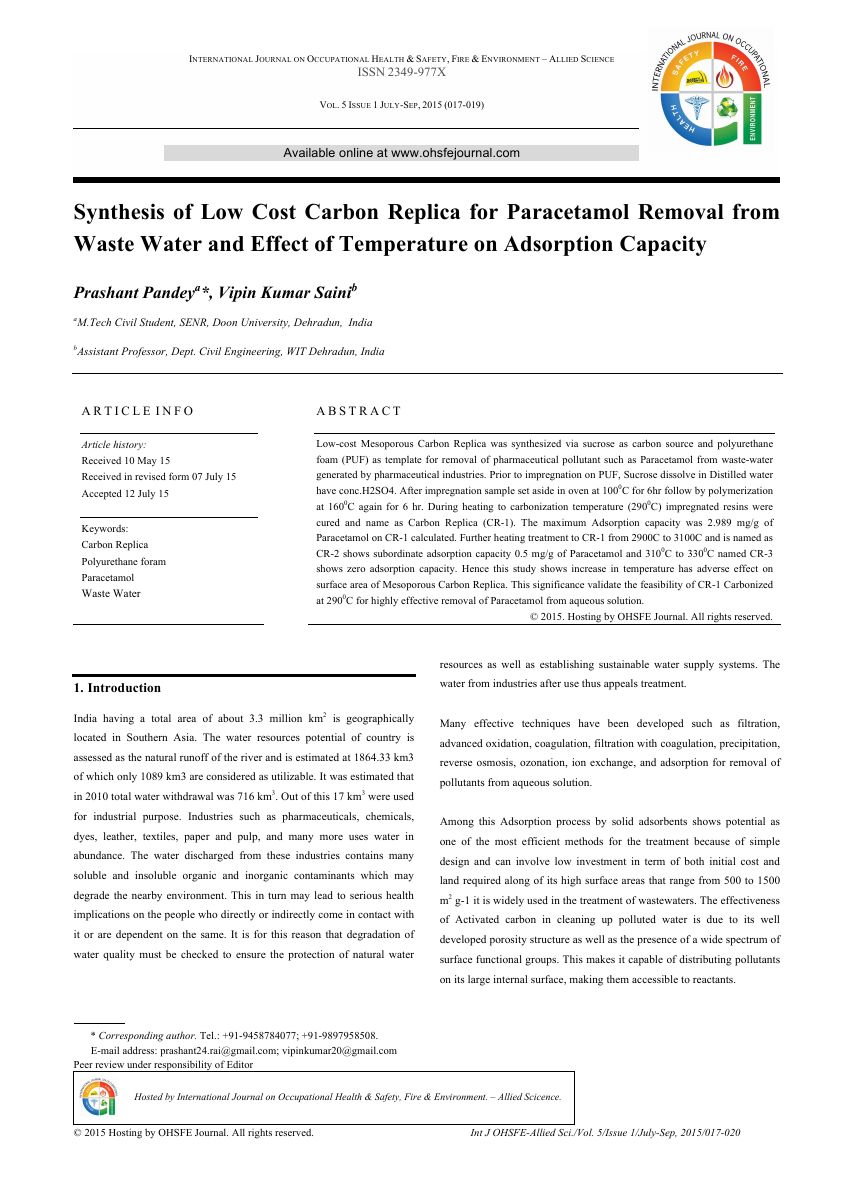
Low-cost Mesoporous Carbon Replica was synthesized via sucrose as carbon source and polyurethane foam (PUF) as template for removal of pharmaceutical pollutant such as Paracetamol from waste-water generated by pharmaceutical industries. Prior to impregnation on PUF, Sucrose dissolve in Distilled water have conc.H2SO4. After impregnation sample set aside in oven at 1000 C for 6hr follow by polymerization at 1600 C again for 6 hr. During heating to carbonization temperature (2900 C) impregnated resins were cured and name as Carbon Replica (CR-1). The maximum Adsorption capacity was 2.989 mg/g of Paracetamol on CR-1 calculated. Further heating treatment to CR-1 from 2900C to 3100C and is named as CR-2 shows subordinate adsorption capacity 0.5 mg/g of Paracetamol and 3100 C to 3300 C named CR-3 shows zero adsorption capacity. Hence this study shows increase in temperature has adverse effect on surface area of Mesoporous Carbon Replica. This significance validate the feasibility of CR-1 Carbonized at 2900 C for highly effective removal of Paracetamol from aqueous solution.
Keywords
First page
 Open full paper ↗
Open or download the original PDF for the complete text, figures, references and citation details.